
When should I begin brushing my baby's teeth?

February 25th, 2015

One question our team at Sidney D. Kelly, DMD Family and Cosmetic Dentistry hear all the time is, “When should I start brushing my baby’s teeth?”

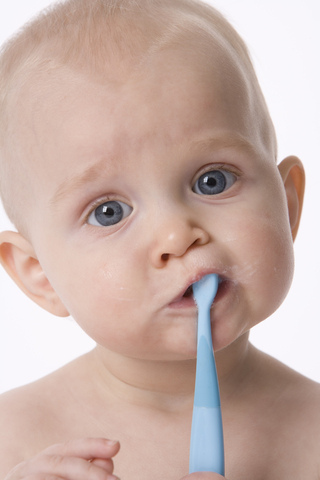
You should begin regular cleanings even before your baby has teeth. After each breast feeding (or bottle-feeding) use a clean, damp washcloth to gently rub your baby’s gum tissue. You may wrap the material around one finger to make it easier to remove any food bits from your baby’s mouth.

When your baby’s first tooth comes in, switch to a baby toothbrush. Look for special baby toothbrushes in your drugstore; they have just a few bristles and are very soft. There are even brushes shaped like finger puppets that fit over the tip of your pointer finger! All you need at this point is water (no toothpaste yet).

After a few more teeth appear, you may start using toothpaste, but you only need a tiny bit, and make sure it doesn’t contain fluoride for the first two years. From the beginning, have your little one practice spitting the toothpaste out after brushing. That way, he or she will already have the good habit of spitting when you switch to fluoride toothpaste, which should never be swallowed.

If you have any questions about caring for your baby’s teeth, or to schedule an appointment at our convenient Roseville, CA office, please contact Sidney D. Kelly, DMD Family and Cosmetic Dentistry.

Sealants Protect Your Child’s Teeth from Decay

February 18th, 2015

Sealants provide a thin coating over molars that can be a powerful tool to protect your child’s teeth from decay. This simple and painless solution can be applied in a matter of minutes by our team at Sidney D. Kelly, DMD Family and Cosmetic Dentistry, forming a protective shield and avoiding costly and painful cavities or other forms of tooth decay later.

The Causes of Tooth Decay

Our mouths are routinely filled with germs and bacteria. Some of these bacteria can be helpful in converting the foods we eat (especially sugars in the food) into acids that our bodies use to break down food. However, when we eat too much sugar, the excess acids can cause cavities and other decay in teeth.

Molars (our chewing teeth) are prime sites for tooth decay because they have rough surfaces with lots of little grooves where small food particles and germs find places to stay for extended periods of time. If you can prevent tooth decay in your child’s teeth now, you may be able to avoid treatments for decaying teeth later in life—costly and painful procedures like crowns and fillings.

Protecting Against Decay

A comprehensive plan for mouth care can protect against tooth decay. This plan should include:

  • Drinking water with fluoride in it or using other fluoride supplements
  • Eating a healthy diet (avoiding excessive sugar)
  • Brushing teeth regularly
  • Applying sealants

On their own, each of these activities is good but does not provide enough protection against decay. Fluoride is best for protecting the smooth surfaces of our front teeth, but may not provide enough of a shield for our rough, uneven back teeth. In addition, toothbrush bristles may not get to all the tiny food particles and germs in our mouths. For these reasons, sealants are the recommended preventive measure for molars in the fight against germs.

Who needs sealants, and when?

The best time to get a sealant is when your child’s adult teeth are just growing in. Between the ages of about five and seven, children grow their first permanent molar teeth, and they grow a second set of permanent molars between the ages of 11 and 14. Sealants placed on these teeth as soon as they grow in will be most effective in preventing tooth decay before it occurs.

If your child still has his or her baby teeth, Drs. Sidney and Jacob Kelly may recommend sealants for teeth that are especially rough or uneven and may be prone to tooth decay. When your child loses his or her baby teeth, we will apply new sealants to the permanent teeth when they grow in. In addition, our team may recommend sealants for adults in special cases; for example, if a previously placed sealant falls out, if you never had sealants put in as a child, or if your teeth are prone to decay and the preventive treatment may help.

Talk to us during your next visit at our Roseville, CA office to learn more about how dental sealants can help protect your child’s teeth.

Valentine's Day History

February 11th, 2015

Valentine’s Day is best known as a celebration of love in all its forms. Pink hearts, red roses, and cute greeting cards adorn every surface you see. What many people don’t realize is that the modern Valentine’s Day celebration arose from a religious holiday.

St. Valentine’s Day was originally celebrated as a religious feast day in honor of early Christian martyrs. Three martyrs named Valentine were honored: a priest in Rome, the persecuted bishop of Interamna (a town in central Italy), and a saint martyred in Africa. This saint’s day was celebrated throughout Christendom, although it was removed from the Roman Catholic Calendar of Saints in 1969.

The origin of Valentine’s Day as a holiday for lovers began with Geoffrey Chaucer in his 1382 poem “Parlement of Foules.” Chaucer wrote, “For this was on Saint Valentine’s Day, when every bird cometh there to choose his mate,” and the modern romantic holiday was born. William Shakespeare and other writers mentioned Valentine’s Day as a day of love.

Valentine’s Day as we know it came about in the early 19th century. In Victorian England, printers began manufacturing small numbers of cards with romantic verses, lace, ribbons, and other frills. Anonymous Valentine’s Day card were a popular way for young lovers to exchange romantic sentiments in an otherwise prudish time. As the 19th century progressed, printers began mass manufacturing Valentine’s Day cards. People in the United States give an estimated 190 million valentines every year, and up to one billion if you count children exchanging cards at school! With the rise of the Internet, Valentine’s Day e-cards have become a popular mode of communication, with millions of e-cards sent each year.

The other items associated with Valentine’s Day include chocolate and flowers. The tradition of giving chocolates has been around for decades, and Richard Cadbury created the first box of Valentine’s Day chocolates nearly 150 years ago. Today, purchases of chocolate total over $1 billion in the United States alone, with 35 million heart-shaped boxes sold each year. Loved ones also exchange flowers, with red roses being associated with Aphrodite, the Greek goddess of love. On Valentine’s Day itself, florists sell nearly 200 million stems of roses.

Although many people dismiss Valentine’s Day as a commercialized “Hallmark holiday,” it is beloved to couples and romantics across the United States and other countries. The team at Sidney D. Kelly, DMD Family and Cosmetic Dentistry wants to remind all patients that no matter what your celebratory plans, February 14th can be a wonderful day to celebrate the loved ones in your life. Happy Valentine’s Day!

February is Heart Month

February 4th, 2015

The American Academy of Periodontology stresses the importance of good oral health since gum disease may be linked to heart disease and stroke. Thus far, no cause-and-effect relationship has been established, but there are multiple theories to explain the link between heart disease and periodontal disease. One theory suggests that oral bacteria may affect heart health when it enters the blood and attaches to the fatty plaque in the heart's blood vessels. This can cause the formation of blood clots. Another theory suggests the possibility that inflammation could be a contributing link between periodontal disease and heart disease. Gum disease increases plaque buildup, and inflamed gums may also contribute to the development of swollen or inflamed coronary arteries.

What is coronary artery disease?

Coronary artery disease is caused in part by the buildup of fatty proteins on the walls of the coronary arteries. Blood clots cut off blood flow, preventing oxygen and nutrients from getting to the heart. Both blood clots and the buildup of fatty proteins (also called plaque) on the walls of the coronary arteries may lead to a heart attack. Moreover, periodontal disease nearly doubles the likelihood that someone will suffer from coronary artery disease. Periodontal disease can also worsen existing heart conditions, so many patients who suffer from heart disease need to take antibiotics before any dental procedures. This is especially true of patients who are at greatest risk for contracting infective endocarditis (inflammation of the inner layer of the heart). The fact that more than 2,400 people die from heart disease each day makes it a major public health issue. It is also the leading killer of both men and women in the United States today.

What is periodontal disease?

Periodontal disease is a chronic inflammatory disease that destroys the bone and gum tissues around the teeth, reducing or potentially eradicating the system that supports your teeth. It affects roughly 75 percent of Americans, and is the leading cause of adult tooth loss. People who suffer from periodontal disease may notice that their gums swell and/or bleed when they brush their teeth.

Although there is no definitive proof to support the theory that oral bacteria affects the heart, it is widely acknowledged better oral health contributes to overall better health. When people take good care of their teeth, get thorough exams, and a professional cleaning twice a year, the buildup of plaque on the teeth is lessened. A healthy, well-balanced diet will also contribute to better oral and heart health. There is a lot of truth to the saying "you are what you eat." If you have any questions about you periodontal disease and your overall health, give our Roseville, CA office a call!

Contact Us!
call email