January 28th, 2015

Also known as onchophagia, the habit of nail biting is one of the so-called “nervous habits” that can be triggered by stress, excitement, or boredom. Approximately half of all kids between the ages of ten and 18 have been nail biters at one time or another. Experts say that about 30 percent of children and 15 percent of adults are nail biters, however most people stop chewing their nails by the time they turn 30.
Here are four dental and general reasons to stop biting your nails:
1. It’s unsanitary: Your nails harbor bacteria and germs, and are almost twice as dirty as fingers. What’s more, swallowing dirty nails can lead to stomach problems.
2. It wears down your teeth: Gnawing your nails can put added stress on your pearly whites, which can lead to crooked teeth.
3. It can delay your orthodontic treatment: For those of our patients wearing braces, nail biting puts additional pressure on teeth and weakens roots.
4. It can cost you, literally: It has been estimated that up to $4,000 in extra dental bills can build up over a lifetime.
Drs. Sidney and Jacob Kelly and our team recommend the following to kick your nail biting habit:
- Keep your nails trimmed short; you’ll have less of a nail to bite.
- Coat your nails with a bitter-tasting nail polish.
- Ask us about obtaining a mouthguard, which can help prevent nail biting.
- Put a rubber band around your wrist and snap it whenever you get the urge to gnaw on your nails.
- Think about when and why you chew your nails. Whether you are nervous or just bored, understanding the triggers can help you find a solution and stop the habit.
- If you can’t stop, behavioral therapy may be an effective option to stop nail biting. Ask Drs. Sidney and Jacob Kelly and our team for a recommendation.
January 21st, 2015

Recently, multiple studies have concluded that people with sleep apnea, a disorder that causes snoring, fatigue, and dangerous gaps in breathing at night due to throat muscles collapsing, are five times more likely to develop cancer. In fact, one of the studies found that people with the most severe forms of sleep apnea had a 65 percent greater risk of developing cancer of any kind.
Researchers believe this could be due to the body lacking enough oxygen, a condition known as hypoxemia. When people are deprived of oxygen, their bodies react by producing more blood vessels, which can feed cancer cells, and as a result cause tumors to grow and spread.
Approximately 28 million North Americans suffer from sleep apnea, with many cases going undiagnosed. This is due to most cancer patients not mentioning any sleep problems they experience unless their physician asks them.
Patients at Sidney D. Kelly, DMD Family and Cosmetic Dentistry who suffer from sleep apnea can be treated using continuous positive airway pressure (CPAP) therapy, which produces a stream of air to keep the upper airways open while you sleep. An oral appliance may be another option if CPAP therapy isn’t an option. If you have sleep apnea, Drs. Sidney and Jacob Kelly and our team will help you understand all of your treatment options, finding one that suits your needs.
If you think you may have sleep apnea, please give us a call at our Roseville, CA office to schedule an appointment.
January 14th, 2015
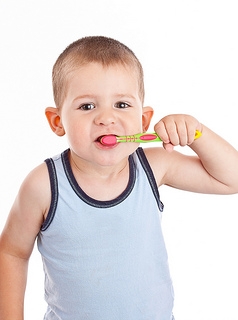
Our team at Sidney D. Kelly, DMD Family and Cosmetic Dentistry would like to offer some tips regarding the sometimes dreaded task of brushing a toddler’s teeth.
Much of the trick lies in the positioning. Before you begin, make sure you are in a position of control. This protects both you and your child from injury. Consider how well you can see. If you cannot see clearly, the quality of brushing drops significantly. For instance, if your child is standing, you are likely to see only the bottom teeth well.
Our team finds that the best position for brushing and flossing a toddler is when your child is calm. Have your child lie down on his or her back with arms out to make a T. Sit down just above the head and lightly place your legs over your child’s arms. Using a circular motion, brush all sides of the teeth.
It may sound odd, but approaching the routine this way can make brushing time a cinch! After you’re done, give your child the toothbrush and let him or her have a turn. The benefit of doing the brushing and flossing first is that it gives an example, which your child is more likely to repeat when you’re done.
Different methods work best for different families and children. These practices need to be performed with kindness and care. Be gentle and make this time a happy learning time. Don’t forget to bring your child to our Roseville, CA office for regular dental checkups and cleanings. Drs. Sidney and Jacob Kelly can advise you on ways to implement portions of these tips in a way that may work bests for you and your child.
January 7th, 2015

At Sidney D. Kelly, DMD Family and Cosmetic Dentistry, we know that unfortunately, gum disease can exist in your child’s mouth without you even knowing. In fact, your child may be suffering from the beginning stages of periodontal (gum) disease without noticing any pain or discomfort. Since gum disease can be undetectable, it’s critical to watch for the warning signs in order to prevent the disease from growing worse!
If your child is experiencing any of the following symptoms, you may want to consider scheduling an appointment with Drs. Sidney and Jacob Kelly as soon as possible:
- Gums that are red or swollen
- Gums that feel tender
- Gums that bleed easily during brushing or flossing
- Gums that are receding
- Persistent halitosis (bad breath)
- Loose teeth
- Any change in the way teeth come together in the biting position
If your child is experiencing these symptoms, schedule an appointment right away by calling our Roseville, CA office. Drs. Sidney and Jacob Kelly and our team can diagnose the problem and begin treatment to save your child’s teeth!
Our team at Sidney D. Kelly, DMD Family and Cosmetic Dentistry looks forward to seeing you!